The Big Read: After more than 500 days, home remains a bridge too far for Malaysians stuck in Singapore
Advertisement
Singapore
The Big Read: After more than than 500 days, home remains a bridge too far for Malaysians stuck in Singapore

For many Malaysians working in Singapore, what they initially thought would be a temporary disruption has turned into an indefinite stay in the Democracy, as the COVID-19 virus refuses to get abroad, forcing both the Singapore and Malaysian governments to continue restricting travel across the Causeway until today. (Photo: Ili Nadhirah Mansor)
- Many Malaysian workers who commute to Singapore daily for piece of work accept been stranded in Singapore since March terminal yr
- Border restrictions, quarantine requirements take made it hard for them to go back dwelling house to their families
- Meanwhile, they accept to grapple with boosted living expenses at an substitution rate that is over three times higher
- Some Singaporeans living in Malaysia are in a similar predicament
- Many are hoping that the situation will amend next calendar month when edge restrictions are expected to ease, notwithstanding they are wary of getting hopes upwards besides loftier
09 Aug 2022 06:21AM (Updated: 09 Aug 2022 06:20AM)
SINGAPORE: The terminal time Mr Lim Kok Leong was able to embrace his then five-year-quondam daughter was on Mar 17 last twelvemonth, more than than 500 days ago.
"Information technology's been really tough ... my little princess. At this age, they abound up very fast. And I've been able to meet that from the chubby and bubbly type, she's growing skinnier and taller day by day … Merely I'm missing out on all of that," said the 43-year-one-time Malaysian, who became a Singapore permanent resident about a decade ago.
For more than half of his life, since 1999, Mr Lim had been making the daily commute across the Causeway from his house in Johor Baru to Singapore, where he currently works as a biomedical engineer.
Merely the COVID-19 pandemic which began raging early last yr threw his daily routine, and his life, into disarray.
Mr Lim has been counting the days: As of Saturday (Aug 7), a total of 508 days have passed since he terminal returned home, causing him "neat hurting".
While stuck in Singapore, Mr Lim yearns to be reunited with his wife and young daughter, likewise every bit his ailing parents and parents-in-police force.
"Many people don't call up it is a big deal. They compare us with the foreign workers who come to Singapore to work but the difference is that before coming, they are mentally prepared to stay here for a few years.
"But we were unprepared. We had one day to come into Singapore. We were told this would last for 2 weeks," Mr Lim said, referring to the Malaysian'due south authorities sudden announcement to impose the first nationwide lockdown last yr.

On Mar xvi last yr, amidst a worrying spike in COVID-nineteen cases, Malaysian Prime Minister Muhyiddin Yassin announced that a "movement control society (MCO)" would exist implemented from Mar 18 to Mar 31 terminal year. The MCO meant that all businesses, except for outlets similar supermarkets and convenience stores, had to shut, along with houses of worship, schools and universities. In that location was besides a ban on mass gatherings.
All Malaysians were barred from travelling abroad, and foreign tourists and visitors were not immune to enter the country. This meant that Malaysian workers in Singapore had simply 1 day to brand arrangements for what they thought would be a ii-calendar week stay here.
The sudden turn of events saw droves of Malaysian working hither rushing to enter Singapore on Mar 17 concluding year, via the Johor-Singapore Causeway. They braved long queues and traffic jams equally they tried to make their fashion into Singapore before the lockdown took event at midnight.
"On that fateful dark on Mar 17, everybody was but rushing in. There were a lot of things that we thought that we could just hold off for 2 weeks, and so we tin can go back again and we can only move on with life," said Mr Lim.
Unfortunately, what many had idea would be a temporary disruption has turned into an indefinite stay in the metropolis, as the coronavirus refuses to go away, forcing both the Singapore and Malaysian governments to go along restricting travel across the Causeway until today.
What was meant to be a temporary relocation for a couple of weeks turned to months, and then to over a year and counting.
The Causeway — once ane of the globe'southward busiest state border crossings, where more than 300,000 Malaysians used to cross it daily pre-pandemic — is at present lifeless, empty of traffic.
Like Mr Lim, fellow Malaysian Muhammad Fariezatul Firdaus Ahmed has also not returned dwelling house since Mar 17 last year.
Equally the youngest son who is unmarried, his family members rely on the 30-year-quondam for financial support. His female parent left her task to await after his begetter who has a stroke and he has a sis who is disabled.
Mr Fariezatul, a cleaner who has been working in Singapore since 2016, as well continues to pay rent monthly for his unoccupied home in Johor Baru, which he used to return to every nighttime.
"I tin't recollect about going home because I take a lot of fiscal commitments dorsum abode.
"I need to stay hither and work but maybe if the cost of returning habitation for a brusque holiday is non such a burden, I would consider it," he said.

OBSTACLES IN THEIR WAY
While the regime in both countries accept introduced a few special schemes to allow some form of travel, many Malaysian workers in Singapore have non been able to take advantage of them due to the sharp rise in COVID-19 cases every now and then, besides as the costs involved.
For case, the Periodic Commuting Organization (PCA) is a travel lane agreed between the ii governments which supports companies in Singapore and Malaysia past facilitating the move of workers, co-ordinate to Singapore'south Immigration and Checkpoints Authorisation's (ICA) SafeTravel website.
Companies which need to bring their employees into Malaysia or Singapore can sponsor an application. Such applications could be made from Aug 10 last year.
Under the PCA, approved travellers or employees are required to remain in their country of employment for at to the lowest degree 90 days earlier returning to their home country for brusque-term domicile go out. Cantankerous-border entry under the PCA is simply permitted via land at the Causeway and Second Link.
Under the PCA, Malaysians returning home from Singapore were initially required to serve a seven-mean solar day home surveillance order and undergo a COVID-19 exam.Those with Johor residential addresses on their identification cards were permitted to cocky-isolate at home until they received a negative COVID-xix test result.
Mr Muhammad Ridzuan Doc Khisban, a 32-year-sometime cleaner, was able to return habitation to Johor in February nether the PCA scheme. Before that, he had not gone dwelling house since Mar 17 last twelvemonth.
He said that back in Feb, he was only required to self-isolate at dwelling house for four days before he received his negative COVID-19 result.
Still, since May xiii this twelvemonth, Malaysia has imposed a strict fourteen-day quarantine for those inbound from Singapore, afterwards the Malaysian regime listed the Republic as one of several countries that have reported the spread of coronavirus variants in the customs.
The 14-solar day quarantine must be carried out at a government-approved facility.
For those arriving in Singapore, they are required to accept a COVID-nineteen Polymerase Chain Reaction (PCR) test at the checkpoint. They must then serve a fourteen-day stay-habitation find (SHN) at a dedicated facility.
Apart from the PCA, in that location is besides the Reciprocal Green Lane (RGL) which was allowed for short-term travel of upwardly to xiv days.
The RGL — which has also been suspended since May 13 — applies merely to essential business or official travellers, and requires a much stricter, controlled itinerary. For instance, these travellers cannot use public ship except for private-rent cars and taxis, dissimilar those under the PCA.
For many Malaysians in Singapore, the quarantine and SHN requirements constitute the biggest stumbling block to a family reunion.
"I want to go abode, even for just a brusk while merely… We have to pay for the quarantine in Malaysia and and so again when we re-enter Singapore. Information technology's actually a brunt," said Mr Fariezatul, who earns up to Southward$1,500 a month including overtime pay.

Quarantine charges in Malaysia commencement at RM150 (Due south$48) per day, depending on the chosen designated hotel, totalling about at least RM2,100 for the 14-24-hour interval menses.
The toll of staying in a SHN dedicated facility in Singapore for 14-days is S$2,000 for a single adult for accommodation and food, according to ICA's SafeTravel website.
Mr Fariezatul, like many Malaysians working here, has already had to grapple with additional living expenses at an exchange charge per unit that is over three times college, due to his prolonged stay in Singapore.
He is paying Southward$200 a month in hire for a room in a Housing and Development Board (HDB) flat which he shares with some other worker. His visitor helps him by paying the other half of his rent which totals to S$400.
"I have no choice just to stay here because if I go back, there are no jobs in Malaysia right now," he said.
"I brand just enough to support my family and sustain my life here … I tin can't actually think well-nigh spending so much money just to go habitation."
In contempo weeks, there accept been calls from Malaysians working in Singapore for the Malaysian regime to remove quarantine requirements for those who are fully vaccinated.
An online petition asking for such a waiver had garnered 17,500 signatures equally at 5pm on Thursday.
Johor Chief Minister Hasni Mohammad, in a tweet accompanying a repost of a news article on the outcome, also said on Aug 2: "Fully vaccinated Malaysians returning from Singapore should complete their 14 days quarantine at home."
2 other land leaders — Johor health and environs committee chairman R Vidyananthan and Johor investment, cooperatives, entrepreneurship evolution and human being resource commission chairman Mohd Izhar Ahmad — had previously made similar calls.
Last month, Mr Muhyiddin said his regime was considering removing the requirement for fully vaccinated travellers arriving in Malaysia to be quarantined at designated facilities. Just no determination has been appear yet.
Mr Ridzuan, the cleaner, was lucky to take his employer, Sembcorp, conduct the cost of his xiv-24-hour interval SHN when he returned to Singapore in March afterward his trip domicile.
"They said they will pay for our first SHN. 2nd time onwards, nosotros take to carry the cost ourselves, but I'm grateful," said Mr Ridzuan.
Mr Ridzuan, who got engaged in Dec 2019, returned abode in February this year to go married so that his wife would be able to intendance for his anile parents and x-year-former son from his previous wedlock while he is working in Singapore.
Like Mr Fariezatul, Mr Ridzuan said leaving his job hither to return to Malaysia is not an option.
"I was without a job in Malaysia for six months before I started working in Singapore. All I can practise is be mindful of how I spend my money here and try to care for my family from distant," said Mr Ridzuan.
He takes home a basic monthly salary of S$i,300, and earns up to S$2,400 including overtime pay. Of this, he forks out S$490 a month for rental.
He said he has started to save up, just in instance, to pay for the quarantine costs as he plans to return home for Hari Raya Aidilfitri around May next year.
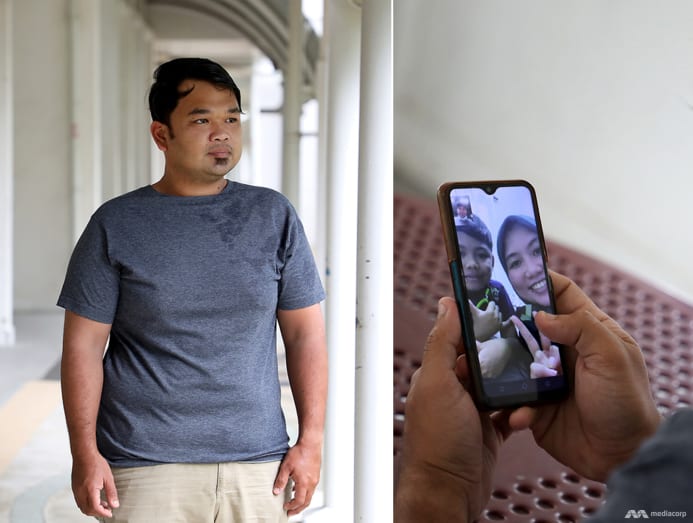
For Mr Lim, the biomedical engineer, the upshot is not so much nigh the quarantine costs that he has to bear. His chore requires him to work onsite and his annual get out will non be able to cover his trip home.
"If I go back, I would desire to spend at least one or two months (in Johor), then it will be worth it. But at most, I volition peradventure get two weeks' off and two weeks is not even able to embrace i quarantine menstruation so it'due south not possible," he said.
NO LAST GOODBYES FOR SOME
While beingness separated for months from their loved ones has acquired much anguish for many Malaysians working here, there are those who take to bear the pain of not being able to pay their last respects to family unit members who have died.
Ms Siti Nur Rahimah Hamdan, who has been working in the hygiene services industry in Singapore for over three years, had planned to return to her home in Ipoh, Perak, on Jun i via the PCA scheme as her begetter had been suffering from complications with his kidneys and diabetes.
However, he died on May 7. When Ms Siti informed her employer, they asked if she wanted to return to Malaysia via the Death and Critically Ill Emergency Visits scheme, where i is immune to attend a funeral or encounter a critically ill family fellow member for about 3 hours before returning to Singapore.
Upon returning to Singapore, she would take to serve a 14-day quarantine.
Since she would have already missed his funeral, Ms Siti decided to stick to her programme of returning to Ipoh on June 1. But when she learnt that from May xiii, the 14-day quarantine would be implemented, she quickly informed her employer that she would like to return before and then.
After reaching Johor Baru on May 12, Ms Siti said that she merely self-isolated for two days earlier receiving her negative event and was immune to become abode to Ipoh."It'south so difficult. So many others have been in this same situation or even worse. At least I could see his (father'due south) grave eventually," she said.
Mr Arafat Mahyiddin, 38, has also been unable to say his final goodbyes to two family unit members who died in Malaysia in the past twelvemonth due to fears that he might non be allowed dorsum into Singapore causing him to lose his job, and also because of the high cost of quarantine.
His brother-in-law died earlier this week after contracting COVID-xix, while his begetter died in Baronial last year.
Autonomously from being financially responsible for his family unit and his wife'southward grandmother, he will now take to help his widowed sis.
"My children, anile 12 and 1, are all the same small… If we work in Malaysia, we are able to be with our families every solar day just nosotros face the risk of uncertain employment and the run a risk of working exterior. The current high number of COVID-19 cases also puts the family at risk.
"Even if we have to be apart, with the salary I receive (working in Singapore), at least nutrient and a roof over my family unit's head tin can nevertheless be guaranteed," said Mr Arafat, who works in logistics.
Mr Arafat besides hoped that the Malaysian government could find some ways to assist Malaysians working in Singapore.
"If every calendar month we are allowed to return to Malaysia for three days without the demand for quarantine, information technology is already sufficient for u.s.a.," he said.

THE SITUATION ON THE OTHER SIDE
For some Singaporeans living in Malaysia, they are in a similar predicament.
Business possessor Rizal Mohamad, who has been living in Malaysia since 2014, said the hardest part about being away from his family is missing special moments with loved ones.
"The last time I saw my niece she was but around eight months old, still not able to walk yet and at present she is already running," said Mr Rizal, who married a Malaysian married woman and settled down beyond the Causeway.
He was last in Singapore in November 2022 and used to visit his extended family here every two to three months.
"Of course I wish to become back. I have non met my parents, grandfather and siblings for almost 18 months now … Thankfully for technology we can video call, merely zero beats coming together them in person," he said.
Mr Rizal'south primary concern, however, is that given "how fast things change", he may not exist able to go dorsum to his married woman in Malaysia if he chooses to render to Singapore, should there exist any new restrictions implemented due to the COVID-xix situation.
The cost of quarantine on both sides is also an issue, "especially with the economy being so bad at present in Malaysia", he said.
"Business owners are the worst hit now. Initially I used to run a travel agency, simply had to pivot the business in order to sustain ourselves," said Mr Rizal, who at present runs Snack Town, an e-commerce platform selling snacks.

Retiree Jamaludin Abd Ghani, 58, who moved to Kuala Lumpur in 2022 after getting married to a Malaysian has non been able to return to Singapore to visit his iv children and grandchildren, two of whom he has not even met.
"The main reason I oasis't been able to go back to Singapore is because of the cost of quarantine and render back to Malaysia," he said.
Foreign nationals, including Singaporeans, will demand to pay an additional RM2,600 for "operational costs", on top of the RM2,100 subsidised fee which Malaysians pay for the accommodation and nutrient during quarantine.
For Singaporeans in Malaysia seeking to return dwelling, the Singapore authorities are open to helping them if necessary.
Mr Sharael Taha, who is a Member of Parliament (MP) for Pasir Ris-Punggol Group Representation Constituency (GRC), said that he has received a range of requests from Malaysians and Singaporeans who wish to travel across the border for a variety of reasons.
"I had one case in May where a Singaporean working in warehousing in Malaysia wanted to come up home for some fourth dimension to visit his family here but as his income was badly affected due to the pandemic, the cost was just as well much to bear. We made an appeal for his stay-dwelling house detect to be waived or partially waived and he was able to come up home," he said.
"When information technology comes to reuniting families or when they need to come in or get dorsum for emergency reasons, the entreatment process is quite shine," he said.
Sembawang GRC MP Poh Li San said that she has received similar requests from Singaporeans and permanent residents who have families in Malaysia. To date, she has helped "at least a dozen" to entreatment through ICA and the Ministry of Foreign Affairs.
"The authorities have been very helpful, we take a few success cases. At that place is a working system in place and information technology's a gamble-based arroyo," she said.
PLEAS FOR HELP
Malaysians in Singapore are also turning to their government to address their state of affairs, though they have not had much luck so far.
On Midweek, a group of seven Malaysians here went to the High Commission of Malaysia to submit a letter asking for the removal of the 14-day quarantine for those who are fully vaccinated.
However, they were prohibited from inbound the bounds equally they did not accept a prior appointment. A security guard afterwards told the group that their letter would be passed to the relevant members in the Loftier Commission instead.
Queries have been sent to the Loftier Commission.
Ms Shama Veswanathan, 42, was amid the group of Malaysians who turned up at the High Committee. She has been working in the security manufacture here since 2013.
"To us, Singapore is a low-risk country ... And then why exercise we demand to quarantine for fourteen days in a hotel when nosotros enter Malaysia? RM2,100 is non a small amount of coin," she said.
"In Malaysia, there are a lot of political matters at the moment. They're more concerned about that… And for us in Singapore, it feels like they have forgotten us."
Political tensions have been rising in Malaysia, with Prime Government minister Muhyiddin under pressure after primal allies withdrew support for his government.
Ms Shama said allowing for home quarantine or reducing the number of days in a facility will not simply lower costs only likewise allow them to spend more time with their families. "Most workers take merely xiv to 21 days almanac leave so we don't need to accept unpaid exit when we go back. We really promise that they will see our letter and they will do something well-nigh it," she said.
Malaysia-Singapore Workers Task Force president Dayalan Sreebalan, who guided the grouping in submitting the letter, said he has received many pleas for help from Malaysians working here, including those seeking legal aid because their spouses are having affairs.
He said that many have also reached out due to financial problems and the need to render abode due to family unit emergencies, such as death in the family. He comes across five to ten death cases daily.
As such, more than needs to exist done for these families who are being kept apart, Mr Dayalan said.
"They are coming from a very safety country (Singapore), they accept all the vaccines, they are willing to practice all the tests that you need and if it'southward negative, what is the point in keeping them in a hotel?"
Akmal Nasrullah Mohd Nasir, the MP for Johor Baru, said that he raised the issue in Malaysia'south Parliament last week but has not received a response from officials if anything volition be done.
"In our country, the Prime Minister has been promising since final calendar week that they will relax some restrictions at to the lowest degree within the country and for interstate travel," he said. "I raised the point then that the Malaysian government will similarly relax restrictions for those Malaysians in Singapore who are fully vaccinated."
Mr Salahuddin Ayub, the MP for Pulai, which is in Johor, said that many of his constituents who used to piece of work in Singapore had since returned to Malaysia or made the decision to leave their jobs before the lockdown was imposed last year.
Calling on policymakers on both sides of the Causeway to look into the situation, he added: "Malaysians need to work, they need Singapore for piece of work. But at the same time, those in Singapore need their families."
Skilful SAMARITANS STEP Forwards
While they are hoping for the regime to meliorate their plight, several Malaysians hither said they are appreciative of what some individuals and firms in Singapore accept been doing for them.
Mr Fariezatul, for example, said that many Singaporeans take rallied around him, and have go almost like "adoptive parents".
One of them is retiree Mohd Razib Ibrahim, 56, who has been distributing packets of food to Malayasian workers here since Mar 18. Currently, he works with charity Willing Hearts to provide over i,100 packets of nutrient to these workers for dinner daily.
"Other than dinner we also provide them with groceries, toiletries and prayer garb, anything that they tin can utilise," said Mr Razib, adding that the items nerveless are donations from his friends.
He added: "Nosotros want to practice what we tin can to help the workers who are hither considering if they go back, they don't have work, times will be very bad."
Since March last yr, real estate house Cushman & Wakefield's facilities and engineering arm, C&W Services, has been paying for the accomodation of 150 of its Malaysian workers. It also provides them with a monthly living allowance to aid them manage Singapore's higher cost of living, said C&West Services managing director Natalie Craig.
"A i-fourth dimension greenbacks payment was also made to them in recognition of their dedication," she said.
She noted that many of the house'south Malaysian workers accept chosen to remain in Singapore to support its operations, even though they would exist separated from their families indefinitely. "We are deeply grateful to them for the sacrifices that they are making, and we feel a stiff sense of responsibility to accept intendance of their well-being," she said.

LIGHT AT THE Terminate OF THE TUNNEL SOON?
Mr Lim, the Malaysian biomedical engineer, said that despite having a stable job in Singapore, he is thinking of quitting to render home to his family if the situation doesn't change by side by side calendar month.
He noted that many of his compatriots working in Singapore are similarly looking forward to Singapore's plans to ease border restrictions side by side month, particularly for vaccinated travellers.
"Nosotros don't know what's going to happen and this feels like information technology's never ending. There has to be a total terminate and so I will accept to make a conclusion. I'm very, very worried most my fiscal situation if I get back, only we only have to trust God," Mr Lim said. "If information technology doesn't open up by then (September), so we have a crude idea that information technology will never open up again forever and so I will proceed to resign."
Still, given how catchy the COVID-19 virus is, many are trying not to get their hopes upwards too high, in case they get dashed again.
Ms Siti added: "Am I hoping for good news in September? Of course… Simply at the same fourth dimension, I don't desire to be likewise hopeful. Every few months final year, we had hope that things would become back to normal. Now it's already August 2021."
For more news like this, visit todayonline.com

Recent Searches
Trending Topics
Source: https://cnalifestyle.channelnewsasia.com/singapore/malaysians-workers-stuck-singapore-289241
0 Response to "The Big Read: After more than 500 days, home remains a bridge too far for Malaysians stuck in Singapore"
Post a Comment